
Recognizing Early Signs of Bearing Cage Failure and How to Prevent Catastrophic Breakdown

Bearing cages play a crucial role in the proper functioning of rolling element bearings by maintaining the correct spacing and alignment of rolling elements. When a bearing cage fails, it often signals an advanced stage of bearing damage that can lead to catastrophic equipment failure. Detecting bearing cage failure early is essential to prevent costly downtime and extensive repairs. This post explains why and when bearing cage failure occurs, the key indicators operators can watch for, what signs could have been detected earlier, and when to escalate maintenance actions. A real-world case study illustrates these points.

Why Bearing Cage Failure Happens
The bearing cage, also called the retainer, keeps rolling elements evenly spaced and guides their motion. Failure of the cage usually results from a combination of mechanical, thermal, and lubrication issues:
Excessive Load or Shock: Overloading or sudden impacts can deform or crack the cage.
Poor Lubrication: Insufficient or contaminated lubricant increases friction and heat, weakening the cage material.
Misalignment: Shaft or housing misalignment causes uneven load distribution, stressing the cage.
Material Fatigue: Repeated stress cycles cause micro-cracks that grow over time.
Corrosion: Moisture or chemical exposure degrades cage material.
Manufacturing Defects: Flaws in cage design or materials can reduce durability.
Typically, cage failure occurs in the later stages of bearing damage progression, after other components such as rolling elements or raceways have already been compromised.

When Bearing Cage Failure Occurs
Bearing cage failure usually happens after prolonged operation under adverse conditions. Common scenarios include:
Bearings running with inadequate lubrication for extended periods.
Equipment subjected to repeated shock loads or vibrations.
Bearings operating with misalignment or shaft deflection.
Bearings exposed to contaminants or corrosive environments.
Bearings nearing or exceeding their service life without proper inspection.
Because cage failure is often a final stage in bearing damage, it signals that the bearing is close to complete breakdown and immediate action is required.
Fingerprints Operators Can Use as Indicators
Operators and maintenance teams can detect bearing cage failure by monitoring specific signs and symptoms:
Unusual Noise: Grinding, clicking, or rattling sounds from the bearing often indicate cage damage.
Increased Vibration: Vibration analysis may show spikes or irregular patterns linked to cage defects.
Temperature Rise: A sudden or sustained increase in bearing temperature suggests friction from cage deformation.
Visual Inspection: If accessible, visible cracks, deformation, or missing cage segments confirm failure.
Lubricant Condition: Presence of metal particles or discoloration in lubricant can indicate cage wear.
Bearing Play or Looseness: Excessive radial or axial play may result from cage distortion.
These fingerprints usually appear when the cage is already damaged but can help confirm the diagnosis before total failure.

Signs of Bearing Cage Failure That Could Have Been Detected Prior to Catastrophic Failure
Since cage failure is a late-stage symptom, earlier signs often appear in other bearing components or operating conditions:
Elevated Vibration Levels: Early vibration changes often precede cage damage.
Lubrication Issues: Low lubricant levels, contamination, or breakdown can be detected through regular oil analysis.
Temperature Trends: Gradual temperature increases over time warn of developing friction.
Misalignment or Shaft Deflection: Regular shaft alignment checks can prevent uneven loads.
Surface Damage on Rolling Elements or Raceways: Pitting, spalling, or corrosion on these parts often occur before cage failure.
Noise Changes: Subtle changes in bearing noise can be detected with acoustic sensors.
Detecting and addressing these early signs can prevent cage failure and extend bearing life.

When to Escalate Maintenance Actions
Knowing when to escalate maintenance is critical to avoid catastrophic failure:
At First Signs of Abnormal Vibration or Noise: Investigate immediately to identify root causes.
If Lubricant Analysis Shows Metal Particles or Contamination: Schedule bearing inspection or replacement.
When Temperature Exceeds Normal Operating Range: Stop equipment if temperature rises rapidly.
If Visual Inspection Reveals Cage Damage: Replace bearing without delay.
After Detecting Misalignment or Shaft Issues: Correct alignment before damage worsens.
When Bearings Reach End of Service Life: Proactively replace to avoid unexpected failure.
Escalation should involve notifying maintenance supervisors, scheduling detailed inspections, and planning bearing replacement or repair.

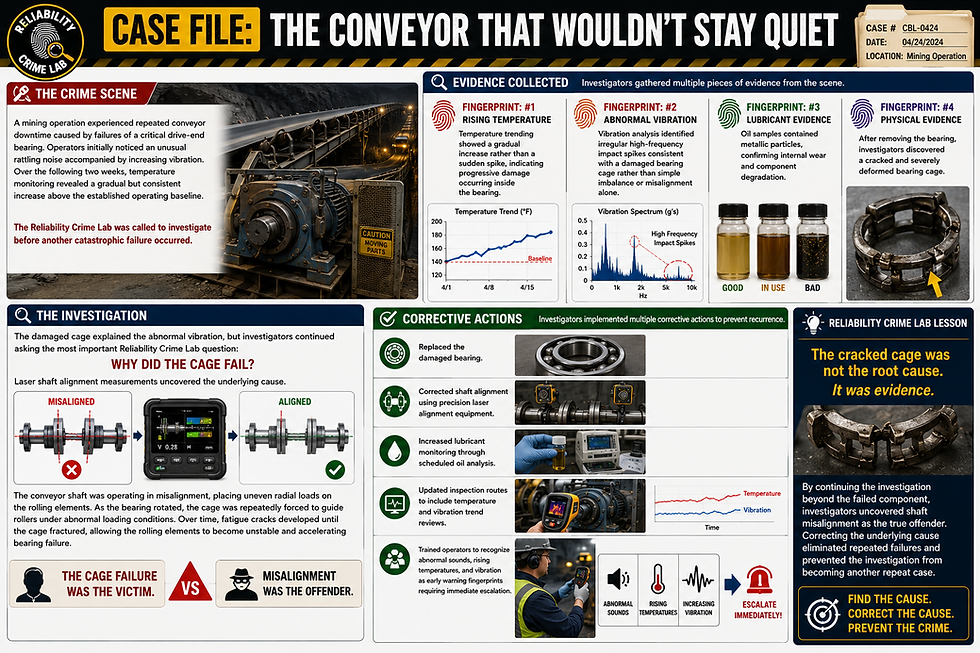
Case File: The Conveyor That Wouldn't Stay Quiet
The Crime Scene
A mining operation experienced repeated conveyor downtime caused by failures of a critical drive-end bearing. Operators initially noticed an unusual rattling noise accompanied by increasing vibration. Over the following two weeks, temperature monitoring revealed a gradual but consistent increase above the established operating baseline.
The Reliability Crime Lab was called to investigate before another catastrophic failure occurred.
Evidence Collected
Investigators gathered multiple pieces of evidence from the scene.
🔍 Fingerprint: #1 Rising Temperature
Temperature trending showed a gradual increase rather than a sudden spike, indicating progressive damage occurring inside the bearing.
🔍 Fingerprint: #2 Abnormal Vibration
Vibration analysis identified irregular high-frequency impact spikes consistent with a damaged bearing cage rather than simple imbalance or misalignment alone.
🔍 Fingerprint: #3 Lubricant Evidence
Oil samples contained metallic particles, confirming internal wear and component degradation.
🔍 Fingerprint: #4 Physical Evidence
After removing the bearing, investigators discovered a cracked and severely deformed bearing cage.
The Investigation
The damaged cage explained the abnormal vibration, but investigators continued asking the most important Reliability Crime Lab question:
Why did the cage fail?
Laser shaft alignment measurements uncovered the underlying cause.
The conveyor shaft was operating in misalignment, placing uneven radial loads on the rolling elements. As the bearing rotated, the cage was repeatedly forced to guide rollers under abnormal loading conditions. Over time, fatigue cracks developed until the cage fractured, allowing the rolling elements to become unstable and accelerating bearing failure.
The cage failure was the victim.
Misalignment was the offender.
Corrective Actions
Investigators implemented multiple corrective actions to prevent recurrence.
Replaced the damaged bearing.
Corrected shaft alignment using precision laser alignment equipment.
Increased lubricant monitoring through scheduled oil analysis.
Updated inspection routes to include temperature and vibration trend reviews.
Trained operators to recognize abnormal sounds, rising temperatures, and vibration as early warning fingerprints requiring immediate escalation.
Reliability Crime Lab Lesson
The cracked cage was not the root cause.
It was evidence.
By continuing the investigation beyond the failed component, investigators uncovered shaft misalignment as the true offender. Correcting the underlying cause eliminated repeated failures and prevented the investigation from becoming another repeat case.
Case Closed
Following implementation of the corrective actions, conveyor bearing failures dropped dramatically, reducing conveyor-related downtime by approximately 80% during the following year.
Reliability Crime Lab principle:
Never stop the investigation at the part failed. Evidence identifies what failed. The investigation must uncover why it failed.
Bearing cage failure signals a critical stage in bearing damage that requires immediate attention. Operators can use noise, vibration, temperature, and lubricant condition as fingerprints to detect cage problems. More importantly, monitoring early signs like misalignment, lubrication issues, and rolling element damage allows intervention before cage failure occurs. Escalating maintenance at the right time prevents equipment breakdown and extends bearing life. Regular inspections, condition monitoring, and prompt action are key to avoiding the costly consequences of bearing cage failure.


Comments