
Across Multiple Industries One Misconnection of an Electrical Switch Can Cost Millions


In manufacturing, one missed click in an electrical connector can lead to massive losses. This issue is especially critical in automotive plants, where thousands of vehicles roll off the line daily. One automotive plant recently faced a crisis when a new model failed quality checks at a staggering 90% rate due to missed electrical connections. This post explores how the problem was investigated, what operators can check before final inspection, and the countermeasures that helped turn the situation around.
Investigating the Root Cause of Misconnection of an Electrical Switch
The plant noticed a sudden spike in defect rates at final stage inspection due to misconnection of an electrical switch. Vehicles were failing electrical system tests, causing delays and costly rework. The investigation team focused on the electrical connectors, which link critical wiring harnesses to various vehicle systems.
Key steps in the investigation included:
Data Collection: Tracking failure rates by production cell and shift.
Visual Inspection: Examining connectors for incomplete mating or damage.
Operator Interviews: Understanding assembly procedures and challenges.
Process Review: Checking if assembly instructions or tooling had changed.
The data revealed that certain production cells had failure rates as high as 90%, while others performed well below 10%. This uneven distribution pointed to operator technique and process consistency as major factors.
What Operators Can Check Before Final Inspection
Operators play a crucial role in preventing missed connections. Before vehicles reach final inspection, they can perform simple checks to catch errors early:
Listen for the Click: Most connectors produce an audible click when fully engaged.
Visual Confirmation: Ensure connectors are flush and locking tabs are fully engaged.
Check for Resistance: Connectors should mate smoothly without excessive force or looseness.
Inspect for Damage: Look for bent pins, debris, or contamination that could prevent proper connection.
Follow Standard Work: Use checklists and standardized procedures to avoid shortcuts.
Training operators to recognize these signs and empowering them to stop the line if unsure can reduce defects significantly.
Measuring Failure by Production Cell
The plant used a measles chart to visualize which production cells had the highest failure rates. This chart helped identify hotspots where missed connections were most common.
Production Cell | Vehicles Produced | Failures | Failure Rate (%) |
Cell A | 500 | 450 | 90 |
Cell B | 480 | 96 | 20 |
Cell C | 520 | 52 | 10 |
Cell D | 510 | 51 | 10 |
The chart showed Cell A was the worst affected, with a 90% failure rate. This cell had new operators and recently changed assembly tools, which likely contributed to the problem.

Why Some Cells Struggled More Than Others
Several factors explained the variation in failure rates:
Switch Location: (Number one reason) switches in a hard-to-reach place can make it nearly impossible to make a good connection.
Sensory Issues: An operator cannot hear the connection "Click"; they rely solely on touch.
Operator Experience: Newer operators in Cell A were less familiar with connector engagement techniques.
Tooling Changes: Cell A introduced new assembly tools that required different handling.
Training Gaps: Inconsistent training led to misunderstandings about connector locking mechanisms.
Workload Pressure: Higher production targets in Cell A caused rushed assembly steps.
Understanding these factors allowed the plant to target improvements where they were most needed.
Primary Findings
1. Switch Location (Primary Contributor)
The connector was located in a confined, difficult-to-access area that limited the operator's ability to see, reach, and properly apply insertion force.
As a result:
Operators could not consistently align the connector.
Hand position reduced insertion leverage.
Full seating was difficult to verify.
Partial engagement became more likely.
This was the largest contributor to the assembly issue.
2. Limited Sensory Feedback
Operators could not reliably hear the connector engagement because of surrounding production noise and the connector's location.
As a result, they depended almost entirely on tactile feedback.
When the tactile feedback was weak or ambiguous, operators believed the connector was fully seated when it was not.
Primary Countermeasure
Instead of immediately redesigning the connector, the assembly process was redesigned.
The workstation layout and assembly sequence were modified to improve operator access to the connector, allowing the connection to be made from a more ergonomic position with better visibility and control.
By improving accessibility, operators could more consistently achieve proper connector engagement without increasing assembly time.
Secondary Countermeasures That Reduced Failures
The plant implemented several countermeasures to address the problem:
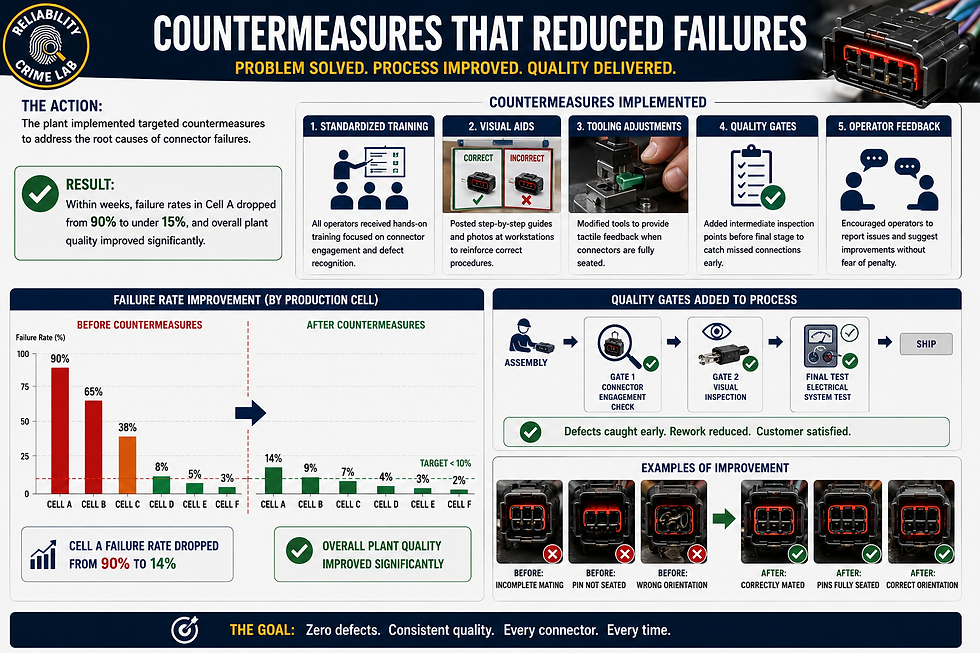
Standardized Training: All operators received hands-on training focused on connector engagement and defect recognition.
Visual Aids: Posted step-by-step guides and photos at workstations to reinforce correct procedures.
Tooling Adjustments: Modified tools to provide tactile feedback when connectors were fully seated.
Quality Gates: Added intermediate inspection points before final stage to catch missed connections early.
Operator Feedback: Encouraged operators to report issues and suggest improvements without fear of penalty.
Within weeks, failure rates in Cell A dropped from 90% to under 15%, and overall plant quality improved significantly.
Practical Tips for Manufacturing Teams
Manufacturers can avoid costly connector failures by:
Training operators thoroughly on connector types and engagement methods.
Using visual and auditory cues to confirm proper connections.
Monitoring failure rates by production cell to identify problem areas.
Implementing intermediate inspections to catch errors early.
Encouraging a culture where operators feel responsible and empowered to ensure quality.
By focusing on these areas, plants can reduce defects, save money, and improve customer satisfaction.
Future Product Improvement Opportunities
Although the process redesign addressed the immediate production issue, future connector designs could further improve assembly robustness by incorporating human-centered design features such as:
Enhanced tactile over-center latch geometry.
Increased audible engagement feedback.
Molded flush-reference features.
Positive insertion stops.
These concepts would provide redundant confirmation of full engagement and further reduce the possibility of incomplete connector seating.
Future Design Countermeasures for Evaluation
Make correct assembly easier to feel, hear, and see without adding another task.
The following concept was not implemented during the original investigation. They are proposed design-level countermeasures intended to make full connector engagement easier to feel, hear, and verify without adding parts or assembly time. Each concept would require prototype testing, ergonomic evaluation environmental validation, and confirmation that the feedback occurs only after complete terminal engagement.
These countermeasures are an improved alternative to adding an inspection step because they redesign the connector to give immediate confirmation during the normal inspection motion.
Sharper over-center latch profile
A more pronounced force drop at full engagement could provide a clearer tactile “snap,” helping the operator distinguish partial seating from complete seating without stopping to check.
The important caution is that the design must not create:
Excessive insertion force
Thumb or hand fatigue
Premature latch wear
Plastic stress cracking
Difficulty disconnecting during service
False engagement caused by the latch snapping before the terminals are fully seated
The key design requirement should be:
The tactile snap must occur only after full electrical and mechanical engagement.

Multisensory Positive-Engagement Connector
A more rebust solution is to redesign the connector so that full seating is confirmed through feel, sound, sight, and a positive mechanical stop all during the operator’s normal insertion motion.
1. Sharper over-center latch geometry, as shown above.
Tune the latch profile to create a pronounced but ergonomically acceptable force drop at full engagement. The operator should feel a distinct tactile “snap” only after the terminals are fully seated.
2. Acoustically responsive housing feature
Incorporate a locally tuned wall or resonant feature near the latch to amplify the natural engagement click. This provides audible confirmation without adding parts, electronics, or assembly steps.
3. Built-in flush reference and insertion stop
Add a molded shoulder, alignment band, or face-to-face reference that becomes flush only at complete engagement. The geometry should also provide a natural physical endpoint to the insertion motion.
Intended Operator Experience
During one normal insertion:
Resistance builds as the connector is pushed together.
The terminals reach full seating.
The latch moves over center.
The operator feels a clear force drop.
The housing produces an audible click.
The connector faces align with the molded flush reference.
Further insertion stops naturally.
This creates four simultaneous confirmations:
Feel it. Hear it. See it. Reach the stop.
Key Design Requirement
The tactile snap, audible click, flush condition, and mechanical stop must all occur only after complete terminal and connector engagement.
This prevents false confirmation where the latch appears engaged before the electrical connection is fully seated.
Expected Benefits
Reduces partial connector seating.
Eliminates the need for a separate verification motion.
Adds no loose parts or secondary devices.
Adds little or no assembly cycle time.
Improves consistency across operators and shifts.
Reduces dependence on visual inspection alone.
Makes the correct condition easier than the incorrect condition.
Validation Requirements
Before implementation, the design should be tested for:
Peak insertion and extraction force.
Operator hand and thumb fatigue.
Tactile force-drop magnitude.
Audible confirmation under actual plant noise conditions.
Confirmation while hearing protection is worn.
Terminal seating before latch activation.
Latch wear over repeated cycles.
Housing stress and plastic fatigue.
Vibration and environmental durability.
Temperature, moisture, dust, and chemical exposure.
Mold filling, warpage, sink, and dimensional variation.
Service disconnectability.
Damaged seals, backed-out terminals, and obstruction conditions.
Recommended Trial Sequence
Start with rapid prototypes using several latch knee angles, flex lengths, and flush-reference geometries. Measure insertion-force curves and eliminate any concept where the latch snaps before terminal seating. Then conduct operator trials to identify the design that provides the clearest confirmation with the lowest ergonomic burden.

Missed clicks in electrical connectors may seem small, but their impact can be huge. The automotive plant’s experience shows that careful investigation, operator involvement, and targeted countermeasures can turn a crisis into an opportunity for improvement. Teams should act quickly to identify weak points and support operators in delivering flawless assembly every time.


Comments