Master Reliability
Acoustic Emission Testing
Conditional Monitoring - NDT
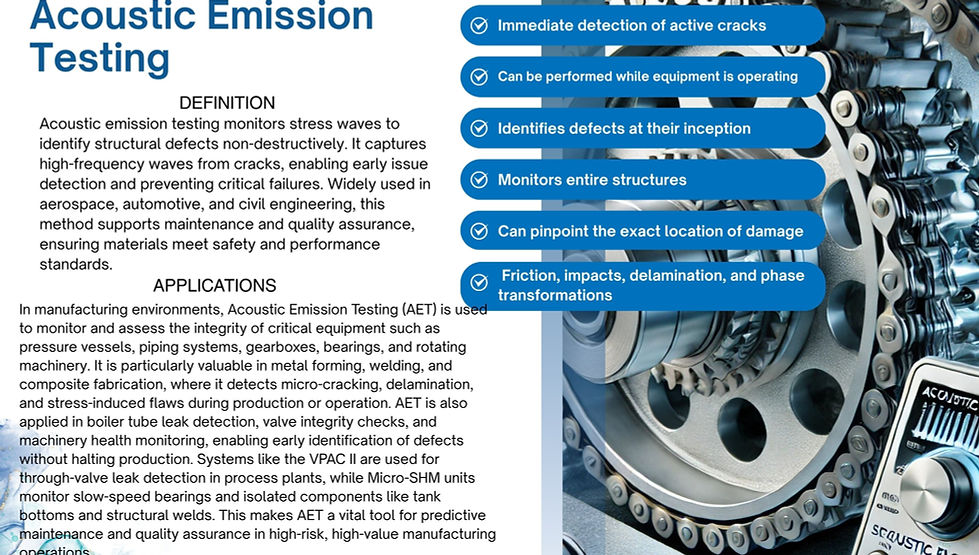
AE testing relies on piezoelectric sensors mounted to the surface of a component or structure to detect high-frequency stress waves emitted by active damage mechanisms. The sensors convert these stress waves into electrical signals, which are then amplified, filtered, and analyzed to determine the location, intensity, and nature of the damage source. Because AE detects only active flaws, it is often used in proof testing, pressure vessel monitoring, pipeline integrity testing, and composite structure evaluation. It offers the ability to monitor large areas from a few sensor locations, making it especially valuable for in-service inspections without interrupting operations.
When to
Use
Acoustic Emission Testing is used in various applications and industries to:
Detect and monitor active defects, cracking, or damage mechanisms in materials, structures, or components under load or stress.
Assess the integrity of critical components, welds, pipelines, pressure vessels, bridges, and infrastructure.
Monitor structural health, fatigue, or degradation over time in aerospace, automotive, civil engineering, and manufacturing applications.
Conduct preventive maintenance inspections to identify defects before they lead to failure
Investigate failure mechanisms, root causes, or sources of anomalies in materials or structures.

