
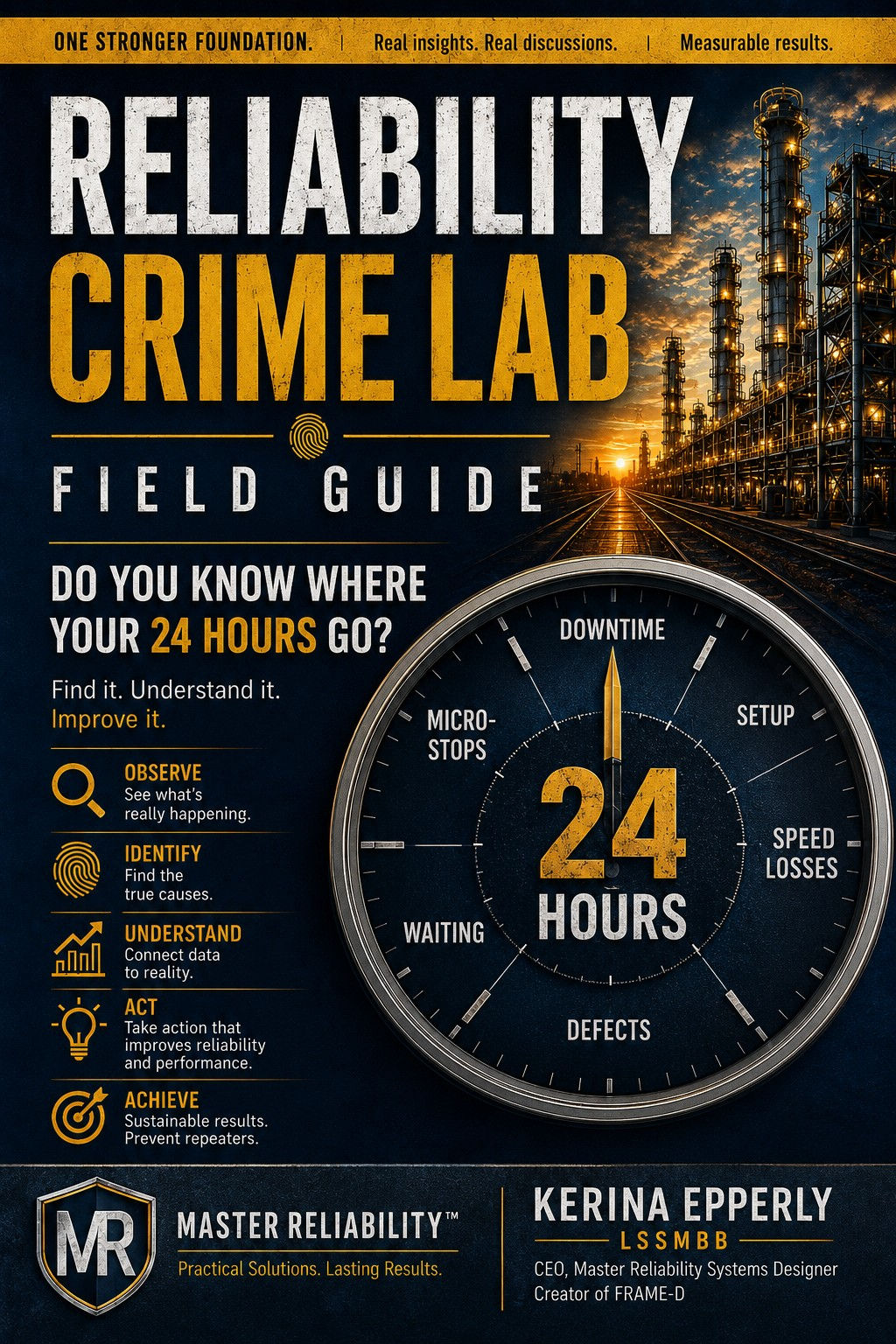

Every manufacturing facility has the same 24 hours.
So why do some plants consistently outperform others?
The answer usually isn't harder work.
It's understanding where the day actually went.
Most organizations measure downtime, scrap, and production. Few understand the hidden factory:
• Waiting for maintenance
• Repeated machine resets
• Micro-stops
• Quality holds
• Informal workarounds
• Speed losses
• Lost opportunities that never make it into a report
Those hidden losses quietly steal capacity every single shift.
That's why I wrote the Reliability Crime Lab Field Guide: Do You Know Where Your 24 Hours Go?
This isn't another textbook.
It's a practical field guide filled with investigations, plant-floor activities, real manufacturing examples, chapter challenges, action tables, and exercises designed to help teams:
- Make the operating day visible
- Build a 24-hour operational timeline
- Separate Value-Added, Business Value-Added, and Non-Value-Added work
- Expose the Hidden Factory
- Prioritize the losses that matter most
- Connect OEE, Reliability, and Continuous Improvement into one practical system
Whether you're an operator, technician, engineer, supervisor, maintenance manager, reliability professional, or continuous improvement leader, the goal is the same:
Stop guessing. Start investigating.
Because you can't improve what you can't see.
- Preorders are now open.
If you've ever looked at yesterday's production report and wondered, "Where did the day actually go?" this book was written for you.
#Reliability #Manufacturing #ContinuousImprovement #OEE #Lean #TPM #RootCauseAnalysis #OperationalExcellence #Maintenance #Industry40 #MasterReliability
Do You Know Where Your 24 Hours Go? eBook
Contents
- Chapter 1: The Case of the Missing 24 Hours
See where your operating day was really spent. - Chapter 2: The Crime Scene
Reveal the Hidden Factory and expose the work your reports never measured. - Chapter 3: Learning to Read the Evidence
Understand OEE, performance, availability, quality, and the hidden losses inside the operating day. - Chapter 4: Interviewing the Witnesses
Conduct effective cross-functional interviews and turn experience into evidence. - Chapter 5: Reconstructing the Timeline
Build the complete 24-hour operating timeline before drawing conclusions. - Chapter 6: Leave No Clue Undetected
Separate value from waste and recognize the clues others overlook. - Chapter 7: Searching the Scene for Waste
Identify abnormal conditions hiding in plain sight. - Chapter 8: Solving the Case of the Missing Minutes
Explain why production was missed even when downtime appeared low. - Chapter 9: Building the Case
Turn measurements into evidence and evidence into conclusions. - Chapter 10: Closing the Case
Turn analysis into ownership and accountability. - Chapter 11: Preventing the Next Crime
Implement sustainable solutions that eliminate recurrence.
- Chapter 1: The Case of the Missing 24 Hours
